Hoplon AI gives growing businesses a complete security operation: the tools, and the agentic AI team that operates them.
Phishing triage starts with an email, but the investigation rarely ends there. A useful response often requires context from endpoint security, identity logs, threat intelligence and activity elsewhere in the organisation.
For a lean IT team, manually pulling that information together can turn one suspicious message into a lengthy investigation.
What is phishing triage?
Phishing triage is the process of determining whether a suspicious message represents a genuine threat, how far the activity has spread and what response is required.
A good phishing investigation should answer questions such as:
- Was the message delivered?
- Which users received it?
- Did anyone interact with the link or attachment?
- Is the sender, domain or file associated with malicious activity?
- Did any affected devices generate related detections?
- Was there suspicious identity activity afterwards?
- Does the event require containment or further investigation?
MITRE ATT&CK classifies phishing as an initial access technique and specifically highlights the importance of correlating email activity with subsequent endpoint, browser and identity behaviour.
Why does a phishing investigation need more than email data?
An email security tool sees the message.
It does not necessarily see everything that happened afterwards.
Consider a phishing email containing a malicious link.
The investigation becomes stronger when the team can connect that message to:
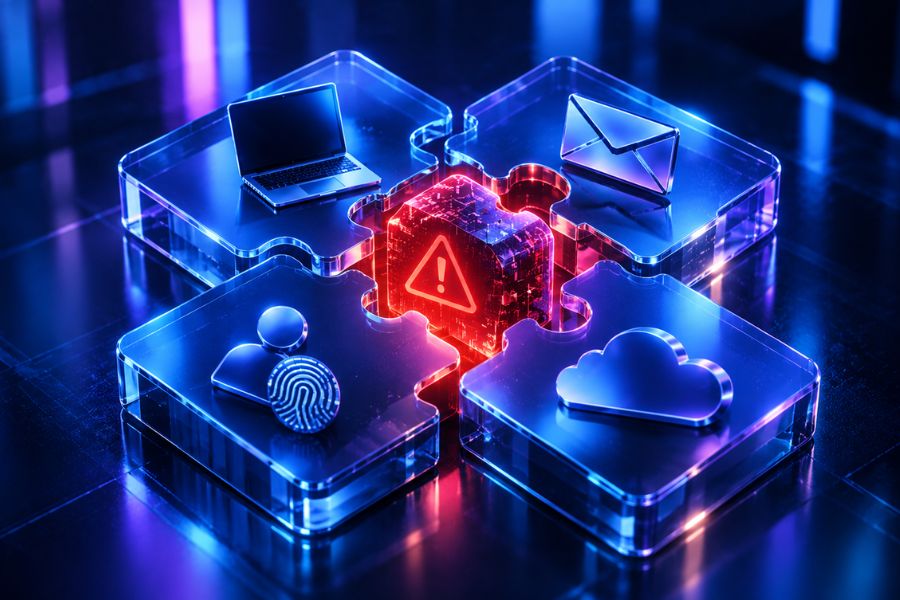
| Signal | What it tells you |
| Who received the message and what it contained | |
| Endpoint | Whether suspicious files or processes appeared |
| Identity | Whether unusual sign-ins followed |
| Threat intelligence | Whether domains, IPs or files are already associated with malicious activity |
| Other users | Whether the same infrastructure targeted anyone else |
MITRE’s current phishing detection guidance explicitly describes correlation between inbound email, suspicious links, subsequent browser activity, processes and identity events as part of detecting phishing behaviour.
That cross-system view is especially important for SMEs that do not have analysts manually watching every security tool.
How does Hoplon correlate phishing signals?
Hoplon’s agentic AI security team investigates across connected security modules rather than treating each alert as an isolated event.
One live cross-module workflow starts with an endpoint detection.
Hoplon can extract the domains contacted during that detection and then identify which users received emails from those same domains.
That creates a direct connection between endpoint and email activity.
Another investigation can start with a file hash and identify every host across the tenant where the same file has appeared.
These are operational queries rather than simple alert aggregation.
If one employee interacts with a malicious message, the investigation can expand to identify related activity elsewhere in the environment.
You can see the broader ecosystem on the Hoplon Integrations page.
How does identity context improve phishing triage?
Credential phishing often moves from email into identity systems.
A user may interact with a fake login page, after which the attacker attempts to access Microsoft 365, Google Workspace or another cloud service.
Hoplon works with Google and Microsoft sign-in logs to add identity context to security investigations.
That allows phishing activity to be reviewed alongside signals such as suspicious sign-ins or related account behaviour.
This is important because a delivered phishing message and a suspicious authentication event occurring close together deserve a different level of attention from a message that was blocked before anyone interacted with it.
Our article on connecting security tools without adding more noise explains why relationships between signals matter more than viewing alerts independently.
How does threat intelligence support the investigation?
A suspicious domain or file does not provide enough context on its own.
Hoplon’s Threat Intelligence Hub is designed to investigate indicators in a way closer to a human analyst workflow rather than relying purely on static matching. Hoplon Intelligence also enriches the investigation with Open Source Intelligence (OSINT), searching relevant information across the public web to uncover additional context, relationships and potential indicators associated with the threat.
Threat intelligence can then be considered alongside what is happening inside the organisation.
For example, a suspicious domain becomes more relevant when:
- an endpoint contacted it
- employees received email from it
- identity activity changed afterwards
- related devices generated additional detections
- open-source web intelligence reveals additional context or connections around the indicator
This makes threat intelligence part of the investigation rather than a separate feed someone needs to check manually.
You can read more in our guide to automated threat intelligence.
What happens when an investigation requires action?
Investigation is only useful if the team can move safely towards response.
Hoplon currently supports 16 agentic action types, each mapped to a risk category and guardrail tier.
Three EDR actions are production-ready:
- scan
- contain
- investigate
Every agentic action passes through Governance Gates.
Depending on its risk category, an action can either auto-execute or require human approval.
Governance Gates also provide:
- full audit logging
- dry-run mode
- capability checks before approval
- opt-in remediation
This matters during phishing response because actions such as containing a user’s device can disrupt legitimate work.
The security team can maintain control over higher-risk actions while allowing lower-risk investigation work to progress faster.
How much time can agentic investigation save?
Phishing investigations often involve repetitive steps.
An analyst may need to move between email security, EDR, identity systems and threat intelligence before deciding whether an event is serious.
In a Hoplon internal benchmark, a security investigation workflow that took approximately 45 minutes manually was reduced to under 5 minutes using the agentic workflow.
For a lean team, that means a suspicious email does not need to consume most of an IT manager’s morning before the team has enough context to make a decision.
It also helps address the wider issue of security alert fatigue by reducing the manual effort required to investigate every signal.
What should a lean IT team expect from phishing triage?
A useful phishing workflow should move quickly from detection to context.
The team should be able to determine:
- what was sent
- who was affected
- what happened afterwards
- whether related activity exists elsewhere
- what response options are available
- whether human approval is required
For SMEs without a dedicated SOC, this level of investigation can be difficult to maintain manually around the clock.
Agentic MDR provides another model by combining the security tools with the operational capacity needed to investigate them.
FAQ
What is phishing triage?
Phishing triage is the initial investigation of a suspicious email or phishing event to determine whether it is malicious, who has been affected and what response is required.
Why should email and endpoint data be investigated together?
A phishing email may lead to file execution, browser activity or other endpoint behaviour. Connecting the two helps determine whether a message progressed into a wider security incident.
Can Hoplon investigate activity across multiple users?
Yes. One live workflow can identify users who received email from domains associated with an endpoint detection, while file-hash investigations can identify other hosts where the same file has appeared.
Can Hoplon automatically contain an endpoint?
Containment is one of three production-ready EDR actions. Governance Gates determine whether an action can execute automatically or requires approval based on its risk tier.
Does Hoplon enrich incidents?
Yes. Hoplon enriches incidents with threat intelligence, internal security telemetry and Open Source Intelligence (OSINT) from the public web, adding context around indicators, related activity and potential threats.
Does Hoplon use Open Source Intelligence?
Yes. Hoplon Intelligence can search relevant public web sources to uncover additional context, relationships and indicators associated with an incident.
Investigate phishing with the full picture
Phishing triage becomes faster when email, endpoint, identity and threat intelligence signals are investigated as part of the same security operation.
Hoplon AI is agentic MDR, the security tools a growing business need, and the AI team that runs them.
Book a Hoplon AI demo to see how the agentic AI security team investigates and correlates security events across connected tools.