Many teams already receive more security alerts than they can properly review.
Endpoint tools, cloud platforms, email security, identity systems, vulnerability scanners, and compliance tools can all produce useful signals. The problem starts when every tool creates its own stream of alerts, and the team has to decide what matters manually.
For lean IT teams, MSPs, and growing businesses, this quickly becomes difficult to manage. More alerts do not always mean better protection. In many cases, they create more work, slower responses, and a higher chance that important risks are missed.
What is alert fatigue?
Alert fatigue happens when teams receive too many security notifications and start to lose the ability to separate urgent issues from low-priority noise.
This does not mean the team is careless. It usually means the security environment has become too fragmented. A login alert may appear in one system. Endpoint activity may appear in another. A compliance issue may sit somewhere else. Each signal may look small on its own, but together they could point to a real security risk.
When those signals are not connected, the team is left to do the hard work manually.
Why more tools can make the problem worse
When alerts become overwhelming, it is tempting to add another tool. Another dashboard. Another monitoring system. Another workflow.
But if the new tool also produces alerts without connecting the wider picture, the team may end up with even more noise.
The real issue is often not a lack of data. Most teams already have enough data coming from their existing tools. What they lack is a clearer way to understand which signals belong together, which risks need attention first, and which alerts can safely be treated as lower priority.
Before adding more technology, teams should ask a simple question:
Are our current tools helping us make better decisions, or are they just creating more things to check?
Connect signals before acting on alerts
Reducing alert fatigue starts with context.
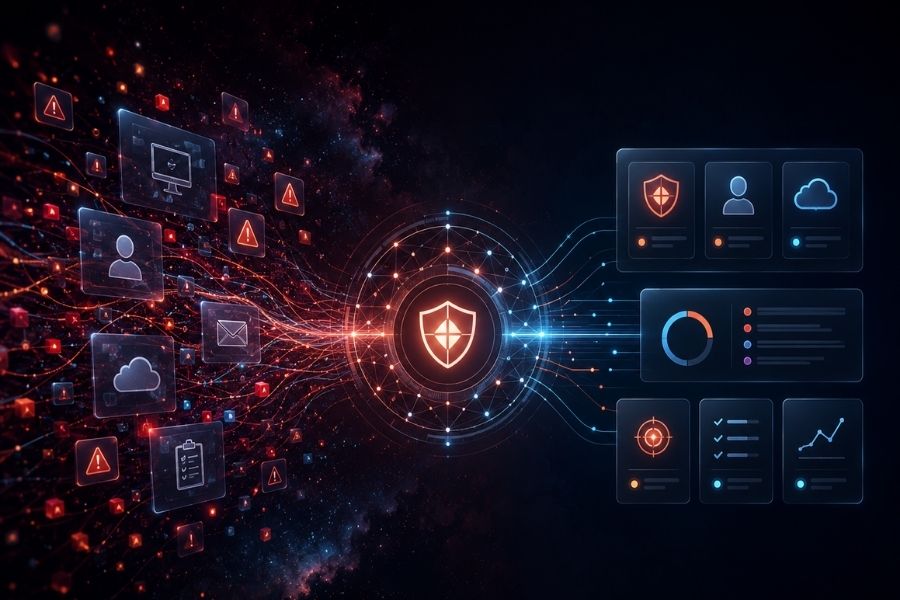
Instead of treating every alert as a separate task, teams need to understand how alerts relate to each other. For example, a suspicious login, unusual device activity, and a failed policy check may be more important when they involve the same user or system.
This is where signal correlation becomes valuable. It helps turn scattered events into a clearer view of risk.
For MSPs, this is even more important. Managing alerts across multiple clients can become slow and reactive if every environment has to be reviewed separately. A connected view helps teams understand where attention is needed without checking every tool one by one.
Prioritise risk, not alert volume
The goal is not to remove every alert. The goal is to help teams focus on the alerts that matter most.
A useful security process should make it easier to answer questions like:
- Which alerts are linked to real risk?
- Which systems or users are affected?
- Which issues should be handled first?
- Which alerts are repeated noise?
- Which actions should the team take next?
When teams can answer these questions faster, they can move from constant review to practical response.
How an AI security layer can help
An AI Agentic Security Layer sits above the tools a team already uses. It does not need to replace the existing stack. Its role is to connect signals, reduce noise, and help teams understand what needs action.
For lean teams, this means less time jumping between dashboards. For MSPs, it means clearer visibility across clients. For growing businesses, it means security becomes easier to manage without adding another heavy system.
HOPLONai helps teams connect their existing security signals, prioritise real risks, and act faster without increasing complexity.
Final thoughts
Alert fatigue is often a sign that security tools are working separately instead of working together.
Adding another tool may help in some cases, but it should not be the first answer. A better starting point is to connect the signals already available, reduce unnecessary noise, and give teams a clearer way to decide what matters.
HOPLONai works as an AI Agentic Security Layer above your existing stack, helping lean teams and MSPs reduce alert fatigue and respond with more confidence.